
Raghbir Singh Brar
FARIDKOT
Email:raghbirsinghbrar@gmail.com
October 8, 2026
As the annual paddy harvesting season commences on October 1, thousands of farmers, laborers, and migrant workers have once again swarmed into the Kotkapura grain market. Spread across roughly 80 acres of land and hosting about 200 commission agents (arhtiyas), this market stands as one of the largest in the region. Yet, for the thousands who must spend days and nights here to sell their produce, accessing the most fundamental human necessities—clean drinking water and working toilets—has become a grueling nightmare.
If you are a farmer who has to sell your produce, whether it is wheat or paddy, you have to suffer badly just to utilize the basic facilities. During the peak season, the wait to sell the crops is notoriously long. Last year, many farmers were forced to camp out for over ten days just to clear their paddy crops, and likewise, they have to sit guarding their wheat produce as well for many days against stray animals and produce lifters.
To survive this ordeal, reliable infrastructure is required. However, an on-the-ground a visit conducted by this reporter on October 7 reveals an unbridgeable gap between government press notes and the harsh reality on the floor.
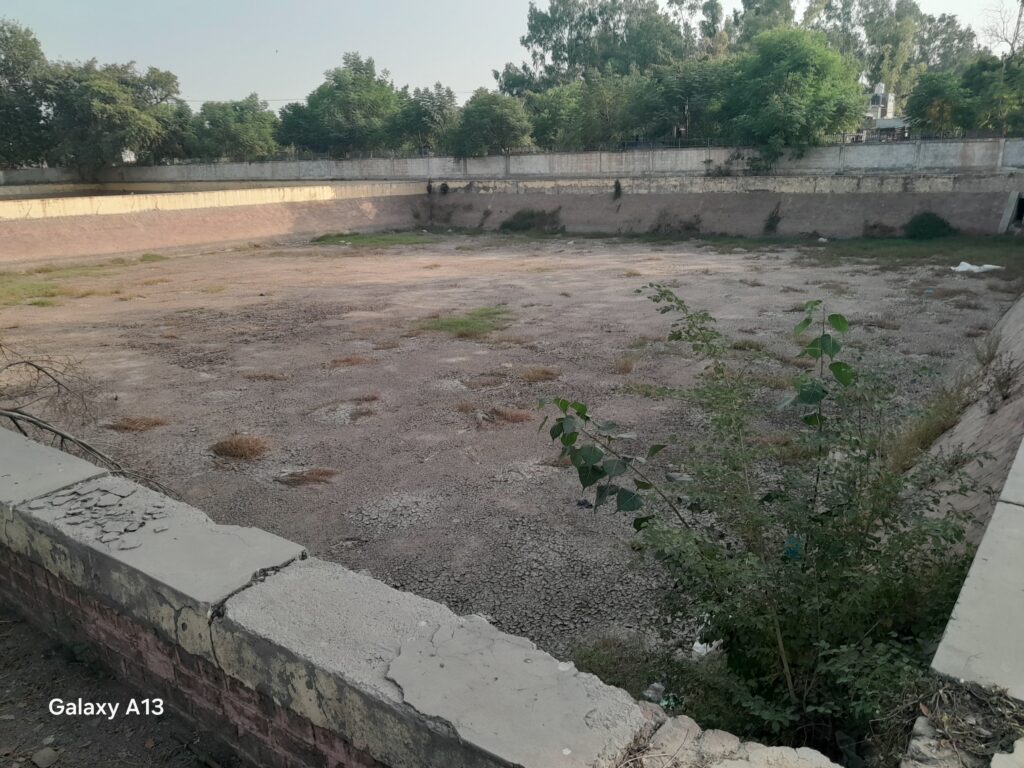
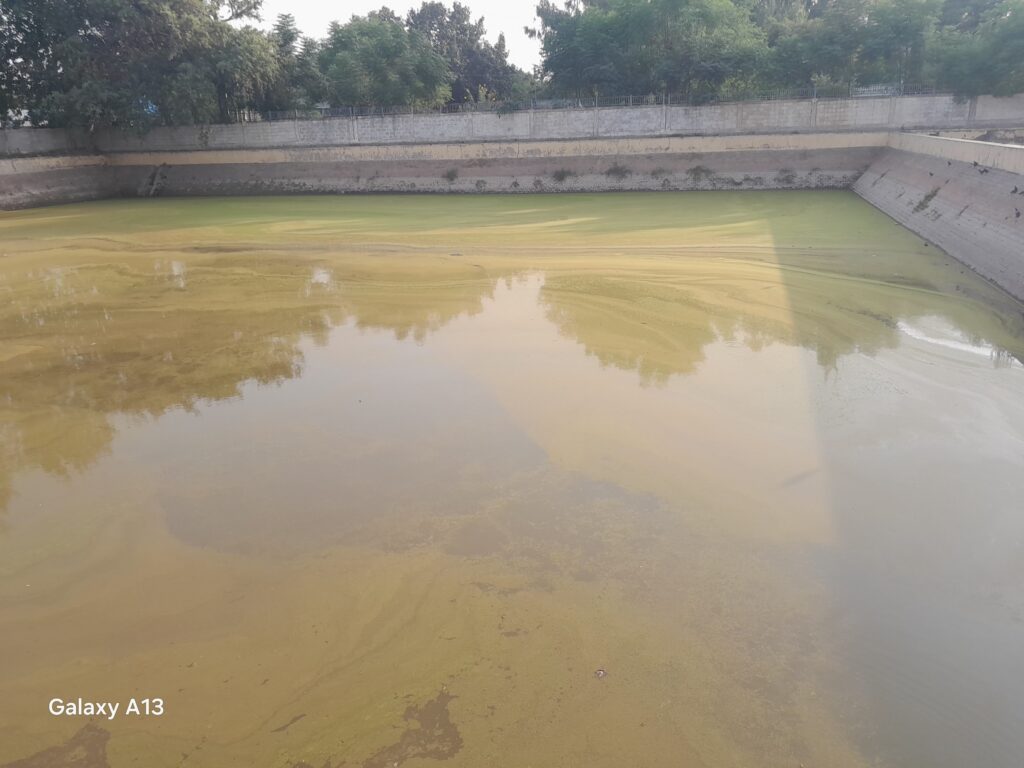
As far as the basic facility of drinking water is concerned, the Punjab Mandi Board has two main storage tanks to supply the entire grain market, including the adjacent vegetable market. The physical tour of the market on October 7 revealed that one storage tank sits completely dry, almost empty, and in desperate need of repair, while the other contains only a very small amount of water.In total, only 8 functioning stand post taps exist across the complex—6 in the grain market and 2 in the vegetable market—while the workers on duty claimed there were 10
.
One stand post tap had been dug up near shops 123-124. The arhtiyas allegedly claimed that its water was being misused by the migrant workers for bathing and washing clothes, leading to the stagnation of water on adjoining places.
“We are on duty to operate the drinking water facility,” said a man present at the premises of the waterworks. “We have over two hundred connections to the shops of the commission agents and 10 stand posts, 8 in the grain market and 2 in the vegetable market. One storage tank has been dried up as it needs repair and the other too has a very low level of water, but we are at present supplying 5 hours of drinking water in the whole market through a borewell facility, with a four-inch (100 mm) velocity.”
Another man present there explained that the system is tied to the canal.
“The water storage tanks only get full when the nearby Rajbaha is full. The water pipes have been laid between the Rajbaha and the facility. The water comes to us through a gravity pull. When the canal water in the Rajbaha is lying low, we do not get water. The water should be sufficiently above the pipes.
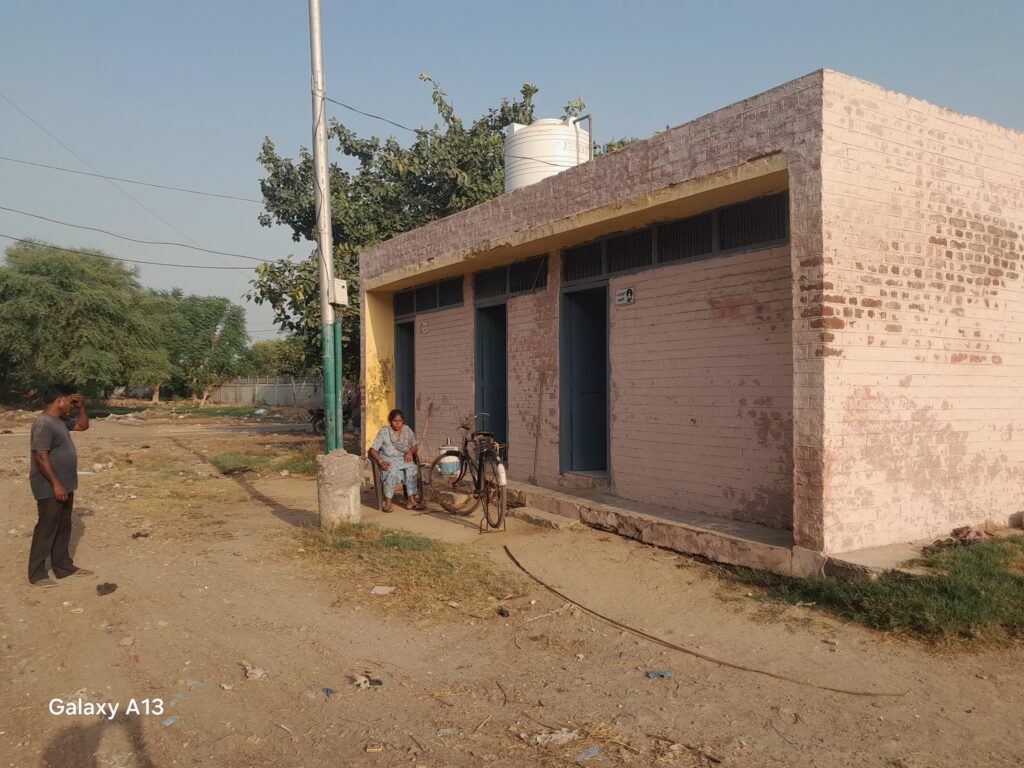
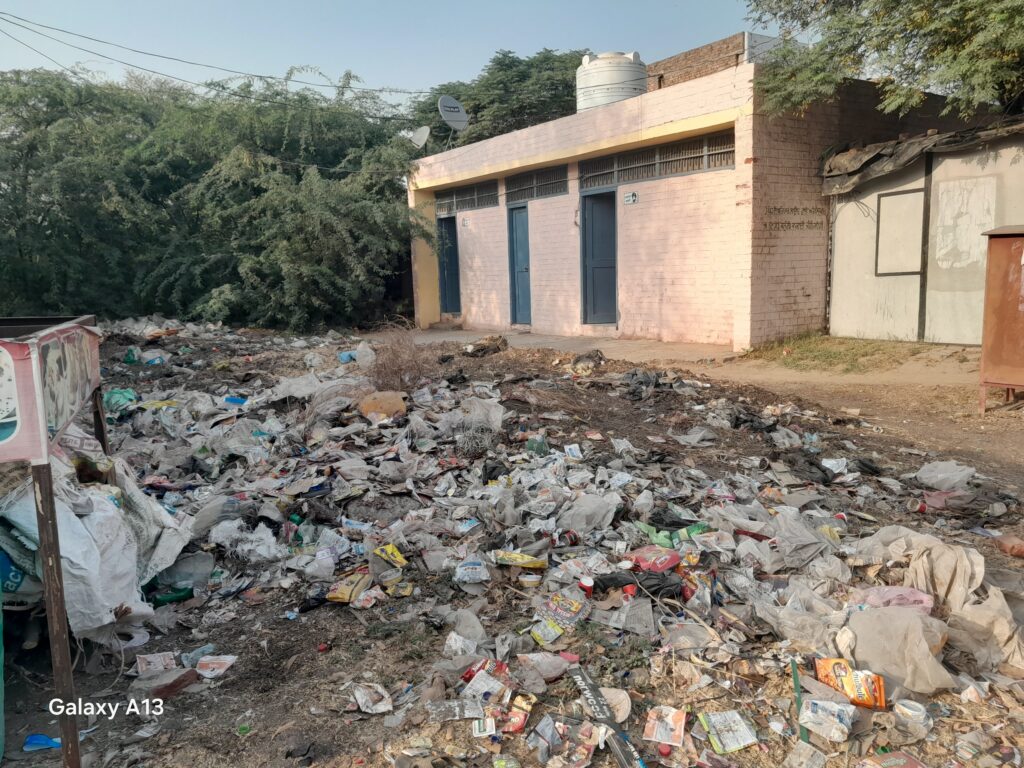
“If the water situation is dire, the state of the toilet facilities is a crude joke to all in the grain market. While there are about 200 commission agents in this vibrant 80-acre market, there are only two toilet facilities in the grain market, constructed on dirty places where, in the peak season, filth welcomes all and one cannot step toward them to use them. Apart from these two, another one is in the vegetable market.
“Yes, there are three toilet facilities in the whole grain market including the vegetable market,” said an employee of the contractor for their management.
“These facilities open at 5 AM and have two seats each for men and women, meaning only four persons can use the facility at a time. All the three are kept clean by us all the time.
“I have just cleaned the facility. I am always there and keep it clean,” added Rinku, a man in his thirties sitting on duty outside the facility at the vegetable market.
The reality, however, remains far away from the tall claims made by the authorities. The math reveals a facility meant for only 8 persons at a time, struggling under a daily footfall of thousands. Open defecation and filthy premises have become a harrowing nightmare in the grain market.
The commission agents also do not provide basic facilities at their shops; they have dirty washrooms because they are used by the labor as well, and they keep their personal ones separate. As a result, farmers have resorted to survival strategies, taking their drinking water from home. They sit turn by turn in the grain market day and night. The farmer who spends the night at the grain market has to rush home to take a bath and use the facilities at home, while the one sitting by day comes back at the end of the day.
One can imagine how far one has to go just to fetch drinking water—which may not even be pure—while managing stray animals and the threat of producing lifters. To make matters worse, there is a dhaba operating just close to a very dirty toilet facility near shop no 35 to 40
Secretary Market Committee speak
.When confronted with these grievances, local officials defended their management.”We have enough drinking water there,” said Harpreet Singh, Secretary of the Market Committee Kotkapura. “We provide drinking water at least 5 places through pots. We put up tents and keep campers and pots there. The arrival has just started, and in the days to come when the footfall increases, we shall provide drinking water at 5 places. As far as the stand posts are concerned, they are meant for the labor who has to use water for washing etc. Farmers need only drinking water as they come from home, and as the grain market Kotkapura is the major market, the basic facilities are being provided by the commission agents because they have their Shop-cum-residences etc.””So are the toilet facilities,” Singh added.
“They are mostly for migrants, and as per the original plan of the grain market, there are only two. Our waterworks are under our civil wing, and if anyone demands to increase the stand posts etc., I shall write to the concerned office.”
Gurmeet Singh Arewala, the Chairman of the Market Committee Kotkapura, stated that if there is any problem on the ground, it would be removed promptly.Ultimately, there remains a massive mismatch deflating all the claims of the concerned authorities and the actual experience had by those on the ground. Until these basic facilities are expanded, the thousands who drive this major agricultural market will continue to face an uphill battle just to sell their harvest.